Anyone who has used a DCP creation tool or studio mastering suite is presented with two options: export as Interop or SMPTE? Both are digital cinema packages, MXF-wrapped picture and sound, an XML composition playlist, and the metadata a cinema server needs to play your film. But they’re different specifications, and picking the wrong one can mean a film you film fails to play.
A quick history
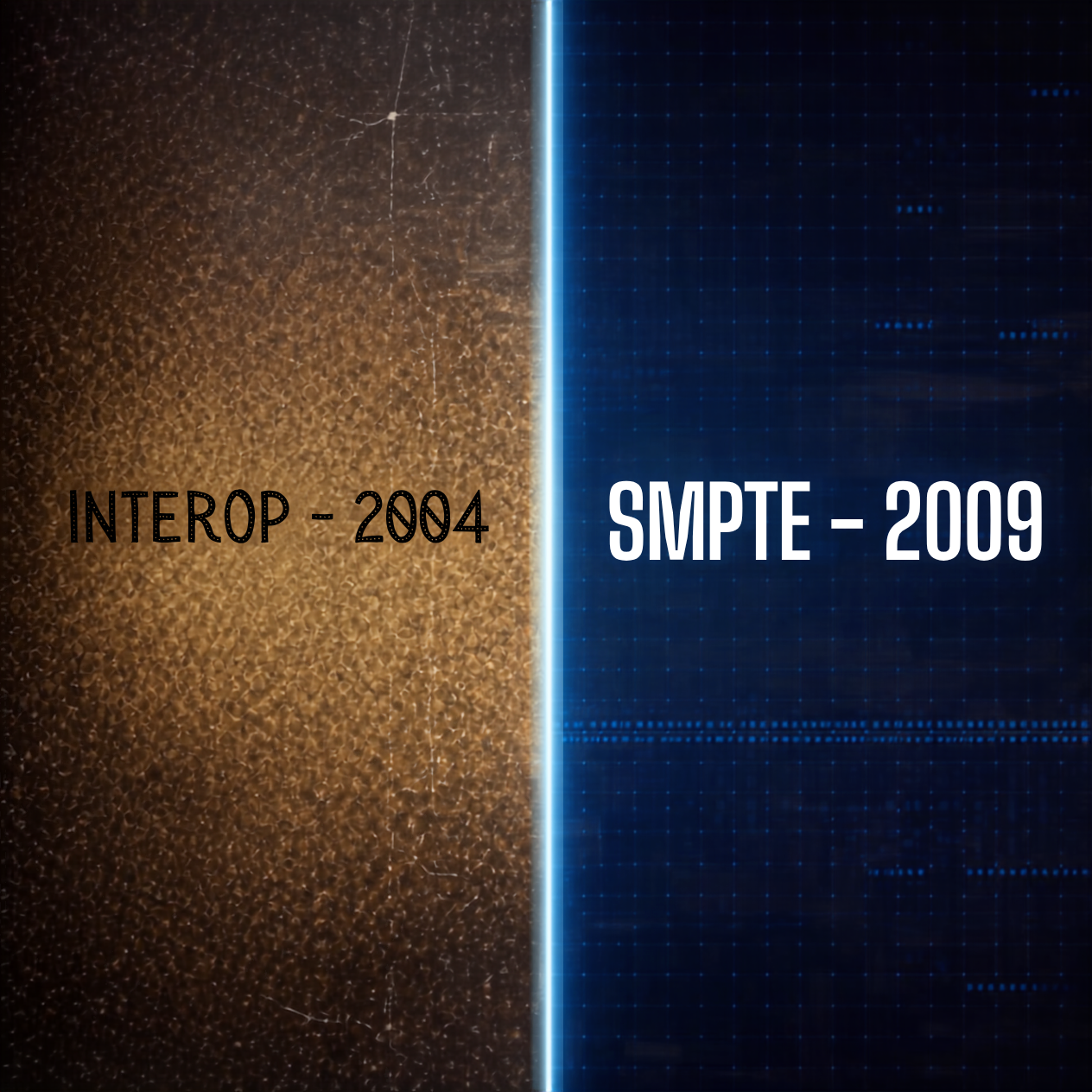
Interop DCP emerged in around 2004 as a practical working draft, meant as a temporary bridge while the industry finished the real standard, SMPTE DCP, which wasn’t finalised until 2009. By then, Interop was already installed in thousands of servers and projectors. Maintenance on Interop continued until around 2012, when the industry agreed to stop developing it further and focus solely on SMPTE. For most of a decade, cinema ran on a temporary format.
What’s different?
CPL structure: both use a composition playlist to organise reels, picture, sound, and subtitles, but the XML schemas aren’t cross-compatible.
Subtitles: the main headache. SMPTE subtitle files are encrypted and structurally different from Interop’s; a server built for one can’t correctly play the other.
Audio track files, are structurally different, which is why some newer audio formats have no Interop equivalent.
Standardisation, SMPTE DCP is a formally published suite of standards; Interop was never formally standardised and survives only as legacy documentation.
Feature support, HFR and object-based audio (e.g., Dolby Atmos) rely on features that exist only in SMPTE. There’s no way to package them in Interop.
Not sure which format fits?
Does this matter?
Yes, but less than before. SMPTE is now the default; major studio releases use it, and it’s the expected format for commercial distribution. Interop hasn’t disappeared, though: it’s still common for archival titles, festival prints, and some European art-house releases, and most modern servers still handle it fine for standard-format DCPs.
It genuinely matters when:
HFR or Atmos is involved, That is for SMPTE only, there’s no workaround.
If encrypted/wrapped subtitles are needed, that requires SMPTE’s subtitle structure.
If legacy hardware is in play, some older Doremi units mishandle encrypted SMPTE subtitles on external storage; some old DLP Series 1 projectors can’t handle SMPTE at all.
Or If a venue has a specific house specifications, sometimes for non-technical reasons (e.g., a festival preferring burned-in subtitles).
Takeaway
All new commercial releases use SMPTE. It’s the standard and required for HFR/Atmos. For an unusual venue, legacy server, or older festival circuit, Its best to check first rather than assume; Interop remains a safe fallback for plain 24fps DCPs without Atmos, HFR, or wrapped subtitles. When converting Interop to SMPTE, budget extra time for subtitles, the structures aren’t compatible and often need to be rebuilt, as conversions often “succeed” while then coming out silent on the caption track.
Bottom line: treat SMPTE as the default, and Interop as the legacy format for specific situations.
Converting Interop to SMPTE?